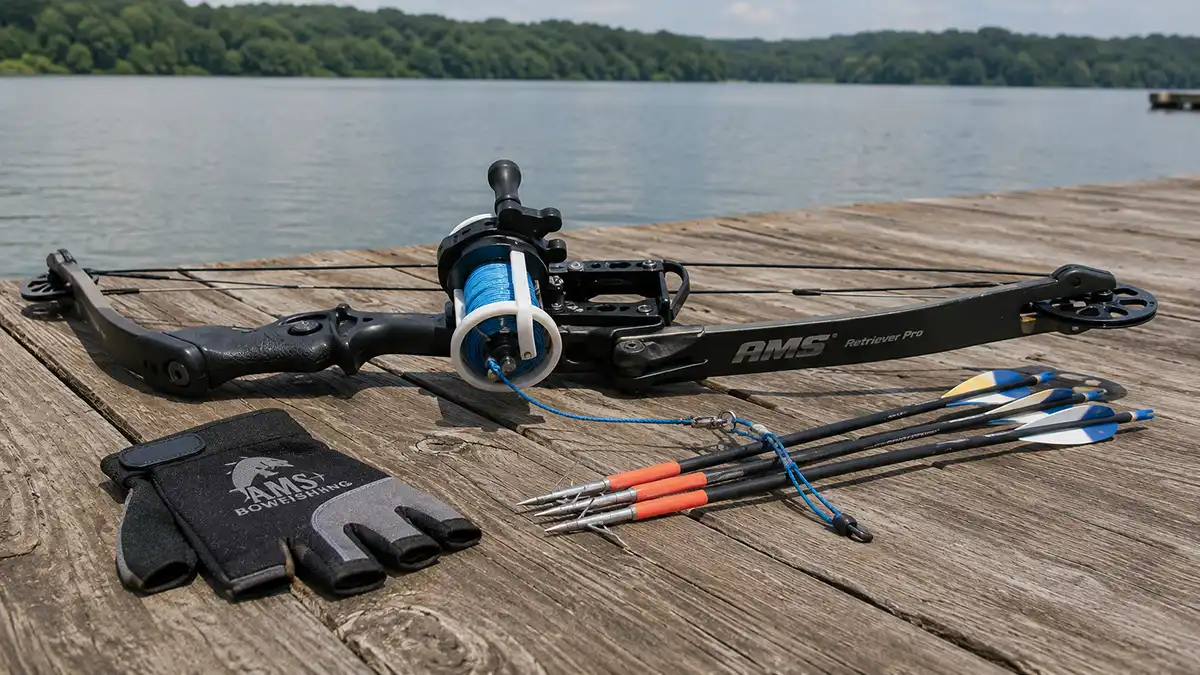
One of the best things about bowfishing is how approachable it is. You don't need a expensive target bow or years of archery experience — just a simple, rugged setup built to shoot into the water and haul fish back. If you're thinking about giving it a try, here's a plain-language guide to the gear a beginner actually needs.
The Bow
Bowfishing bows are built for quick, instinctive, close-range shooting, not long-distance accuracy. Both recurve and compound bows work, and many beginners start with an inexpensive dedicated bowfishing bow or a kit. Draw weight in the 30- to 50-pound range is plenty — you're shooting into water just a few feet away, and lower weights let you shoot repeatedly all night without wearing out. Unlike target archery, you shoot without sights, pointing instinctively like you're throwing a ball.
The Reel
The reel holds the heavy line attached to your arrow and lets you retrieve fish. There are three common types:
- Hand-wrap reel — the simplest and cheapest; a round spool you wind by hand. Reliable but slower.
- Bottle (spincast) reel — a push-button reel mounted in a bottle that lets you retrieve line quickly by cranking, popular for its speed and ease.
- Retriever-style reel — a bottle full of line with a trigger system that many consider the smoothest, tangle-resistant option.
For a first setup, a bottle reel offers a great balance of speed, simplicity, and price.
Arrows and Points
Bowfishing arrows are heavy solid fiberglass — far tougher and heavier than regular arrows — so they punch into the water and stay on target at close range. They're tipped with barbed points that hold the fish once you hit it; most have reversible barbs so you can back the point out to release your catch. Because there are no feathers (fletching would just drag in the water), the arrow flies bare.
The Safety Slide — Don't Skip This
The single most important safety component is the arrow safety slide. It attaches your line to the front of the arrow and slides freely, which prevents the line from tangling around the back of the arrow. Without one, line can catch on shot and cause the arrow to snap violently back toward you — a serious hazard. Always rig a proper safety slide and route your line correctly. Never bowfish without it.
Accessories to Round Out Your Kit
A few extras make bowfishing more comfortable and effective. A finger guard or shooting glove protects your fingers, polarized sunglasses cut glare for daytime shooting, and a good pair of pliers or a fish grip helps you handle toothy gar and slimy carp. If you'll fish at night, add bright lights and a battery. Store your gear so line stays untangled and points are covered.
Start Simple
You don't need top-of-the-line gear to fall in love with bowfishing. A basic bow-and-bottle-reel kit, a handful of arrows with safety slides, and a glove will get you shooting fish your very first outing. Upgrade as you learn what you like. In Kentucky, remember that bowfishing is for rough and nongame fish only and requires a fishing license — check the current Kentucky Department of Fish & Wildlife Resources rules before you go.
Grab an affordable kit, rig it safely, and get out on the water — bowfishing is one of the most fun and beginner-friendly ways to enjoy the sport.